A cross stitch pattern (or chart) is a map of your design on a grid. Every square on the grid is one stitch on the fabric, and a symbol or color tells you which floss to use. That's really all there is to it — the rest is conventions that make big charts easier to follow.
The grid
Each square on the chart equals one square of Aida fabric (or two-by-two threads on evenweave). Charts draw a bold line every 10 squares so you can count quickly: instead of counting 37 squares, you count three bold blocks and seven more.
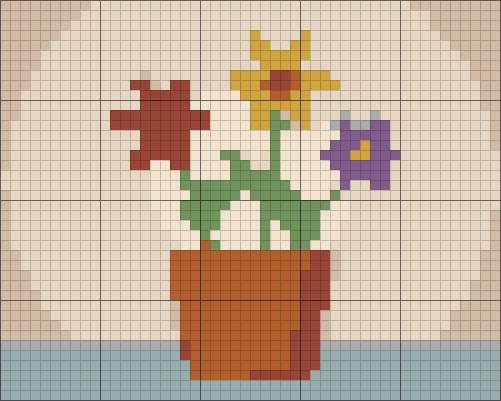 Color chart (50 × 40)
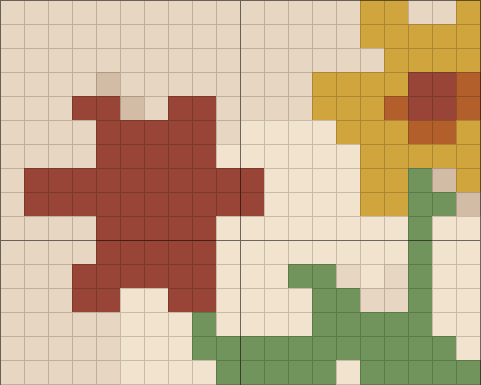 Close-up: 20 × 16 stitches
Most charts also number the grid every 10 stitches along the top and left edges. FlossChart's printed charts do this, and the numbers continue across pages, so column 50 on page 1 is next to column 51 on page 2.
Symbols and the floss key
Printed charts usually use symbols rather than colors, because similar shades are hard to tell apart on paper and in poor light. The key (or legend) lists each symbol with its floss brand, color number, name and often the number of skeins.
| Symbol | DMC | Name | Stitches |
|---|---|---|---|
| ■ | 310 | Black | 1,204 |
| △ | 3865 | Winter White | 860 |
| ● | 321 | Red | 415 |
Some charts show the symbol on top of a colored square ("color + symbol"), which combines the best of both. FlossChart lets you switch between color, symbol and combined views on screen, and prints symbols for clarity.
Find the center and start there
Starting in the middle ensures your design ends up centred on the fabric with even margins. To find the center:
- Fabric: fold it in half both ways and mark the crease intersection with a pin or a water-soluble pen.
- Chart: many charts mark the center with arrows on the edges. Otherwise, divide the width and height by two — for an 80 × 60 pattern, start at column 40, row 30.
Stitch outward from there, finishing one area of color at a time. For big charts, marking the centre lines and a 10 × 10 grid on the fabric saves a lot of counting — see how to transfer a cross stitch pattern onto fabric.
Multi-page charts
Larger patterns are split across pages. A cover page shows the whole design in miniature and the floss key; the chart pages each show one section. FlossChart prints a page header such as "Page 2 of 6 · columns 51–100, rows 1–64" so you always know where you are. Tip: highlight stitched areas on a photocopy, or use a pattern-keeper app with a PDF.
Common stitch types
- Full cross stitch — the standard X, one per square. Most of any chart.
- Half stitch — a single diagonal, used for lighter shading.
- Quarter and three-quarter stitches — partial stitches that smooth curves; easier on evenweave.
- Backstitch — straight lines drawn on top of the chart for outlines and lettering.
- French knots — small dots for eyes or flower centers.
Patterns generated from photos use full cross stitches only, which makes them ideal for beginners.
Reading direction and consistency
Always make the top leg of every X go the same direction (for example bottom-left to top-right, then top-left to bottom-right). Consistent crosses catch the light evenly and look neat. Many stitchers work rows of half stitches left to right and then come back to complete the crosses.
Unstitched areas
Blank squares on a chart mean no stitch — the fabric shows through. In FlossChart you can make any color blank by clicking it in the floss list, a popular way to leave backgrounds unstitched.
A step-by-step first session
- Print the chart and highlight the center.
- Find the color with the most stitches near the center in the floss key, cut an arm's length (about 45 cm / 18 in) of floss and separate the strands you need.
- Bring the needle up at the center of the fabric, leaving a short tail at the back that you'll trap under your first few stitches.
- Stitch every square of that symbol in a 10 × 10 block, then mark them off on your copy of the chart.
- Repeat with the next color in that block before moving to the next block.
Quick glossary
- Count: stitches per inch of fabric (see our Aida count guide).
- Strands: how many of the six floss strands you stitch with.
- Skein: one 8 m bundle of floss (see how much floss).
- Confetti: isolated single stitches (see confetti stitches).
- Parking: a method of working many colors row by row.