Before you upload a picture to a graph maker, decide how big the finished piece should be. In C2C crochet the graph size is the blanket size: every square is one block of a fixed size, so a wider graph means a wider blanket — and more detail. The same is true for tapestry crochet, where every square is one stitch, and for fuse beads, where every square is one bead.
Step 1: start from the finished size
Work out the size you want in inches or centimeters first, then convert it to blocks. Common blanket sizes are:
| Use | Typical size |
|---|---|
| Lovey / security blanket | 14 × 14 in |
| Baby blanket | 36 × 36 in |
| Throw / lap blanket | 50 × 60 in |
| Twin | 66 × 90 in |
| Queen | 90 × 90 in |
Step 2: convert inches to blocks
Divide the size by the size of one block. With typical tension:
- DK yarn, 4 mm hook: one block ≈ 0.65 in, so about 1.5 blocks per inch.
- Worsted yarn, 5 mm hook: one block ≈ 0.8 in, about 1.25 blocks per inch.
- Bulky yarn, 6.5 mm hook: one block ≈ 1.1 in, about 0.9 blocks per inch.
So a 50 × 60 in throw in worsted is about 50 ÷ 0.8 ≈ 63 by 60 ÷ 0.8 = 75 blocks. The table below gives the block counts for every common size, worked out by the same engine the graph maker uses:
| Size | Yarn | Blocks | Rows | Yarn (≈) |
|---|---|---|---|---|
| Baby blanket 36 × 36 in | DK / light worsted | 55 × 55 = 3,025 | 109 | 1,099 yd 1,005 m |
| Worsted / aran | 45 × 45 = 2,025 | 89 | 1,047 yd 958 m | |
| Bulky / chunky | 33 × 33 = 1,089 | 65 | 959 yd 877 m | |
| Throw blanket 50 × 60 in | DK / light worsted | 77 × 92 = 7,084 | 168 | 2,572 yd 2,352 m |
| Worsted / aran | 63 × 75 = 4,725 | 137 | 2,443 yd 2,234 m | |
| Bulky / chunky | 45 × 55 = 2,475 | 99 | 2,178 yd 1,992 m | |
| Twin blanket 66 × 90 in | DK / light worsted | 102 × 138 = 14,076 | 239 | 5,110 yd 4,673 m |
| Worsted / aran | 83 × 113 = 9,379 | 195 | 4,849 yd 4,434 m | |
| Bulky / chunky | 60 × 82 = 4,920 | 141 | 4,330 yd 3,960 m | |
| Queen blanket 90 × 90 in | DK / light worsted | 138 × 138 = 19,044 | 275 | 6,913 yd 6,322 m |
| Worsted / aran | 113 × 113 = 12,769 | 225 | 6,602 yd 6,037 m | |
| Bulky / chunky | 82 × 82 = 6,724 | 163 | 5,918 yd 5,412 m |
Always swatch. Crochet ten blocks by ten blocks, measure, and divide by ten. If your blocks are 0.9 in, use that number instead — over a 75-block blanket, a tenth of an inch per block adds up to 7.5 inches.
Step 3: check the detail
The number of blocks also limits how much of the picture you can show. Think of the graph as a very low-resolution image. Faces need roughly 30–40 blocks across to be recognizable; lettering needs at least five blocks of height per letter, preferably seven.
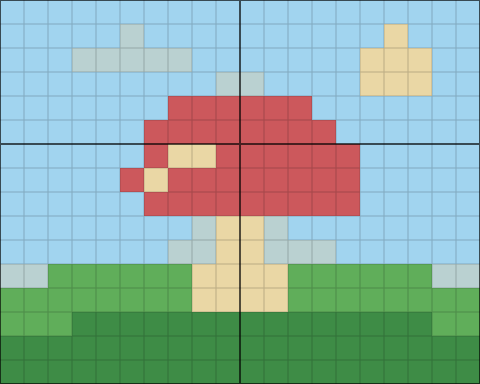 20 blocks wide
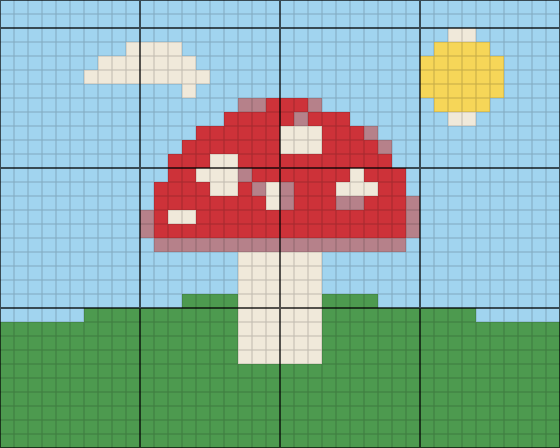 40 blocks wide
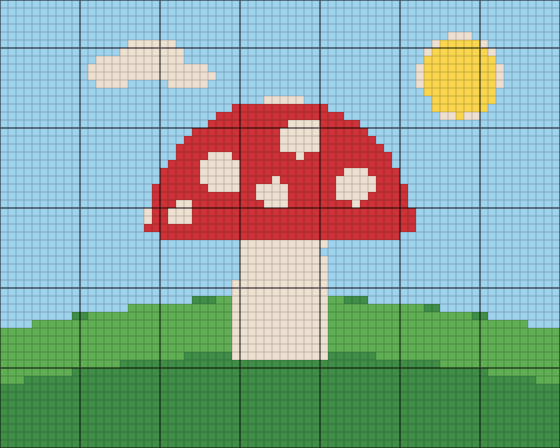 70 blocks wide
If the picture needs more detail than your blanket size allows, you have three options: crop the picture to the important part, simplify it (fewer colors, bolder outlines), or switch to a thinner yarn so you get more blocks into the same size. A DK baby blanket of 36 inches has about 55 blocks across; the same blanket in bulky yarn has only about 33.
Step 4: check the time
Block count is a good proxy for time. Speeds vary a lot, but roughly 60–150 C2C blocks an hour is typical once you are in the rhythm — fewer on rows with lots of color changes. That gives these ballpark figures:
- Baby blanket in worsted (≈ 45 × 45 = 2,025 blocks): about 14–34 hours.
- Throw in worsted (≈ 63 × 75 = 4,725 blocks): about 32–79 hours.
- Queen in worsted (≈ 113 × 113 = 12,769 blocks): about 85–210 hours.
If the numbers look daunting, a smaller blanket with a border, or a pillow cover, is a great first graphghan.
Keeping the picture's proportions
The graph maker keeps your picture's proportions by default: you set the width and the height follows. To make a blanket of an exact size — for example 45 × 45 blocks — untick "Keep photo proportions" and enter both numbers. The picture is then cropped from the center to fit. Crop your photo yourself first if the important part is not in the middle.
For tapestry and mosaic crochet the squares are single crochet stitches, which are a little wider than they are tall. The maker adds about 10% more rows to compensate, so circles stay round. For fuse beads the squares are perfectly square, and the natural sizes are multiples of the 29-peg board: 29, 58 or 87 beads.
Rectangles and C2C rows
A C2C graph of W × H blocks has W + H − 1 diagonal rows. Rectangles have a middle section where the rows stay the same length, increasing on one side and decreasing on the other. That is perfectly normal; the written pattern marks exactly which rows do what. See how to read a C2C graph for the details.
Summary
- Pick the finished size.
- Swatch and measure one block.
- Blocks = inches ÷ block size, for width and height.
- Check that the picture still reads at that size; crop or simplify if not.
- Estimate yarn: blocks × yards per block × 1.1 (see the yarn guide).
Then open the graph maker, enter your width and height, and upload your picture.