Most pixel art projects that stall do so in the gathering phase. A 64 × 64 wall needs 4,096 blocks; a single map needs over 16,000. Knowing exactly what you need — and how to store and farm it — is the difference between finishing and giving up.
Reading the material list
The generator lists every block in your image with four numbers: the total count, the number of stacks (64 blocks each, rounded up), the number of shulker boxes as a decimal, and a breakdown like 1 SB + 5 × 64 + 12. That breakdown means one full shulker box, five more stacks and twelve loose blocks — exactly what to put in your inventory.
The totals line shows the whole build. For the 64 × 64 concrete sample on this site, that is 4,096 blocks = 64 stacks ≈ 2.4 shulker boxes across 9 colors.
Stacks and shulker boxes
- A stack is 64 blocks for all the blocks this generator uses.
- A shulker box has 27 slots, so it holds 27 stacks = 1,728 blocks.
- A double chest has 54 slots = 3,456 blocks, or 54 shulker boxes if you store boxes inside it.
- Your inventory has 36 slots; with a full set of shulker boxes that’s 62,208 blocks on you at once.
To convert by hand: divide the count by 64 and round up for stacks; divide by 1,728 for shulker boxes. The stack & shulker calculator does it for any number.
Trim the palette to what you have
Often a handful of colors make up most of the image, and some rare colors appear only a few dozen times. If one of those is expensive or awkward — a dye you don’t have a farm for, or a diamond block in the full palette — click it in the material list to exclude it. The image is immediately re-matched using the remaining blocks.
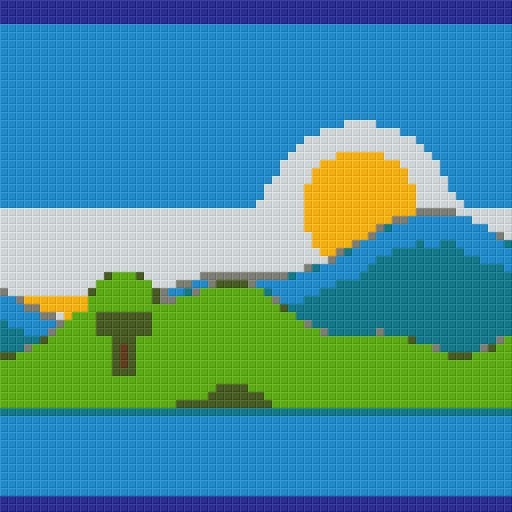 All concrete colors
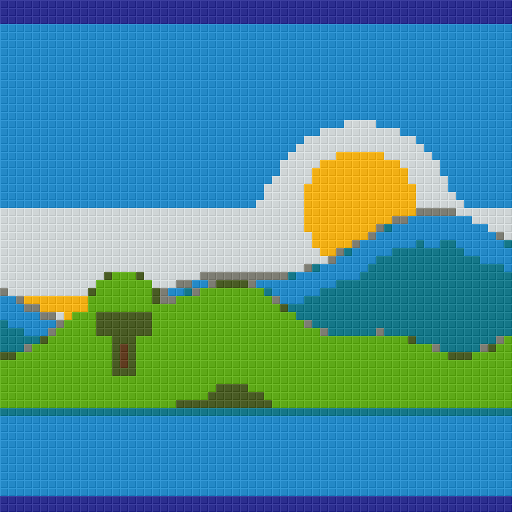 3 colors excluded
The difference is often barely visible, while the material list gets shorter and cheaper. Exclude the least-used blocks first and stop when the preview starts to suffer.
Wool
Wool is the easiest palette to farm. Each sheep regrows its wool after eating grass, and shearing gives 1–3 wool. A pen of 20–30 sheep on grass with a dispenser of shears or a simple manual loop produces thousands of wool per hour. You can also dye the sheep themselves so they grow colored wool, which saves a dye per block.
Dyes come from flowers (most colors), cactus (green), cocoa beans (brown), lapis (blue), bone meal (white), ink sacs (black) and sea pickles (lime). Combining dyes gives the rest: for example light blue from blue + white, or magenta from purple + pink.
Concrete
Concrete powder is crafted from 4 sand + 4 gravel + 1 dye and gives 8 blocks. So for every 8 concrete you need 4 sand, 4 gravel and 1 dye — a 64 × 64 wall needs roughly 2,048 sand and 2,048 gravel. Sand comes fastest from deserts with an Efficiency shovel; gravel from beaches, rivers or a wandering trader. Convert powder to concrete by placing it against water and mining it, or with a water-line converter.
Terracotta
Badlands (mesa) biomes have entire mountains of naturally colored terracotta: orange, yellow, red, white, light gray, brown and plain. For other colors, smelt clay blocks (not clay balls) into terracotta, then dye 8 terracotta with 1 dye. Clay is common in lush caves, rivers and swamps.
Map art blocks
Map art uses a broader mix: concrete for most colors, plus grass, leaves, planks, stone, ores and nether blocks for the rest. Big ones to plan for are usually white and light gray (skies and highlights) and grass or leaves (landscapes). Leaves must be placed by a player so they don’t decay. The noobline needs one extra block per column — any block works.
Organising the build
- Sort the material list by count (it already is) and gather the top three colors first.
- Fill a shulker box per major color and one mixed box for the small ones.
- Keep the CSV export open on a second screen or print it, and tick colors off as you go.
- Bring 5–10% extra of every color. Misplaced blocks and miscounts happen.
With everything boxed and labelled, the build itself becomes the fun part: open the row guide, start at row 1 and work your way up.